|
High-Precision Engineering: The 7mm Nylon Cable Protection Solution |
|
In today’s fast-evolving landscape of micro-automation, medical robotics, and precision electronic manufacturing, managing dynamic utility lines within extremely restricted physical envelopes is a constant engineering challenge. As dynamic mechanisms become increasingly compact and operationally intense, protecting delicate electrical wiring, sensor leads, and pneumatic micro-hoses requires purpose-built guiding systems. The high-performance nylon cable carrier engineered with an internal clearance height of 7mm represents the ultimate synthesis of structural strength, compact design, and operational longevity. |
|
Defining the 7mm Small Drag Chain |
|
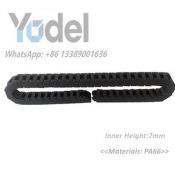
A 7mm small drag chain is an ultra-low-profile dynamic cable carrier manufactured from high-grade reinforced polyamide (PA66). Featuring an internal cavity height of exactly 7mm, this specialized carrier is built to organize, support, and shield delicate conductors during rapid linear and multi-axis movements. |
|
Unlike standard industrial cable tracks that require substantial mounting clearance, the drag chain 7mm series is engineered specifically for micro-space integration. It consists of interlocking, precision-molded links that articulate smoothly along a fixed bending radius. This ensures that internal wires and micro-tubing remain protected from severe bending strain, outer jacket abrasion, and mechanical fatigue. |
|
Key Features and Engineering Advantages |
|
Ultra-Compact Profile for Space-Constrained Enclosures The primary structural advantage of a 7mm small drag chain is its ability to operate seamlessly inside minimal clearance spaces where larger industrial chains cannot fit. It enables machine builders to downsize gantry profiles and internal housing designs without sacrificing component protection.
|
|
Durable, High-Grade PA66 Nylon Construction Constructed from high-tensile, wear-resistant reinforced nylon, this micro cable carrier offers low mass inertia, exceptional fatigue resistance, and thermal stability across a broad operating temperature range (-40°C to +120°C). The lightweight material reduces drive torque requirements on small servo and stepper motors, enhancing energy efficiency.
|
|
Quiet, Low-Vibration Operation Featuring tight manufacturing tolerances at the link pivot joints, the drag chain 7mm provides smooth articulate motion with minimal mechanical vibration. This whisper-quiet performance is essential for cleanroom environments, desktop automation, and clinical diagnostic machinery.
|
|
Extending Cable Service Life Delicate sensor wires, optical fibers, and pneumatic lines are vulnerable to internal copper fatigue and jacket wear when subjected to uncontrolled twisting. By maintaining a uniform bending curvature and isolating moving conductors from external structural edges, a 7mm small drag chain drastically reduces equipment downtime and maintenance costs.
|
|
Primary Application Scenarios |
|
The versatility and mechanical reliability of a nylon micro cable carrier make it an indispensable component across various advanced technology sectors: |
|
Medical and Laboratory Automation: Guides micro-tubing and sensor cables in automated pipetting platforms, blood analyzers, and robotic liquid handlers where precision and cleanliness are paramount. |
|
3D Printers and Desktop CNC Machinery: Protects printhead wiring harnesses and spindle lines along compact X and Y axes without adding unnecessary moving mass. |
|
Semiconductor and Electronics Assembly: Powers high-speed Surface Mount Technology (SMT) pick-and-place nozzles, micro-soldering arms, and optical inspection heads. |
|
Precision Camera Rigs and Optical Scanners: Ensures clean, snag-free cable routing for sliding camera gantries, laser scanners, and diagnostic sensors. |
|
Conclusion |
|
When spatial constraints demand an uncompromising balance of protection and compactness, incorporating a specialized drag chain 7mm system is the ideal choice. By deploying a high-quality 7mm small drag chain, plant operators and machine designers can optimize low-profile automation workflows, prevent cable failure, and ensure long-term operational reliability. |